We are pleased to provide Chemical Vapor Deposition (CVD) coating processes as part of our standard line of wear-resistant coatings. As one of the first companies in North America to provide CVD coating services for tools, we have many decades of experience in applying these coatings across a wide range of manufacturing applications. Our CVD coatings will help our customers unlock the full potential of their tools.
What is CVD Coating?
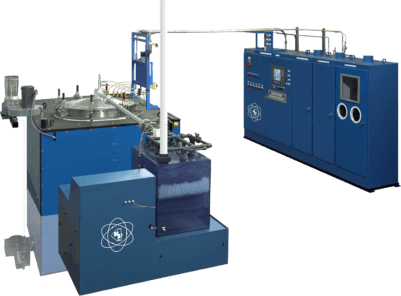 Chemical Vapor Deposition (CVD) is an atmosphere controlled process conducted at elevated temperatures (~1925° F) in a CVD reactor. During this process, thin-film coatings are formed as the result of reactions between various gaseous phases and the heated surface of substrates within the CVD reactor. As different gases are transported through the reactor, distinct coating layers are formed on the tooling substrate. For example, TiN is formed as a result of the following chemical reaction: TiCl4 + N2 + H2 1000° C → TiN + 4 HCl + H2. Titanium carbide (TiC) is formed as the result of the following chemical reaction: TiCl4 + CH4 + H2 1030° C → TiC + 4 HCl + H2. The final product of these reactions is a hard, wear-resistant coating that exhibits a chemical and metallurgical bond to the substrate.
General Characteristics of CVD Coatings
- Processed at atmospheric pressure or in vacuum
- Reactions take place on the surface of the parts, with the coating exhibiting a chemical and metallurgical bond to the substrate
- Metal ceramic films exhibit a high micro-hardness (2400-3400 HV), typically in excess of 80 HRc, depending on film composition
- Coatings will typically exhibit a low coefficient of friction (0.15 – 0.35) depending on film composition
- CVD is an additive process, with an average film thickness of .006 – .009 mm., or .00024 – .00035 inches
- High processing temperature (~ 1925° F)
- CVD is better able to coat internal surfaces than a PVD process.
- Pre- and post-coating polishing can achieve good final finishes
- Post-coating heat treating is required on steel tools
CVD Coatings in Metal-Forming Application
CVD coatings are used in many manufacturing applications as a wear-resistant coating: carbide milling and turning inserts, wear components, some plastic processing tools, etc. However, the most common application for CVD coating is for metal-forming tools. CVD coatings provide excellent resistance to the types of wear and galling typically seen during many metal-forming applications.
In high stress metal-forming applications, where the tool’s tolerances and substrate permit, high temperature CVD coating processes will perform better than “cold” processes like PVD, thin-dense chrome (TDC), nitriding, etc. The chemical/metallurgical bonding that results from the CVD coating process creates adhesion characteristics that simply cannot be duplicated by a “cold” process. This enhanced adhesion protects forming tools from the sliding friction wear-out caused by the severe shearing stresses generated in heavy metal-forming applications.
Titankote™ CVD Coatings
| Proprietary Name | Composition | Color | Thickness (microns) | Micro-Hardness (HV) | Coefficient of Friction | Maximum Working Temperature | Coating Process Temperature |
|---|---|---|---|---|---|---|---|
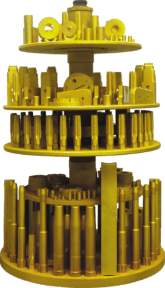
| Titankote™ H | TiN/TiCN/TiC/TiN | Gold | 4-12 | 2400-3200 | 0.35 | 600˚C/1112˚F | 1050˚C/1922˚F |
| Titankote™ H+ | TiC | Gray | 4-12 | 3200-3400 | 0.35 | 600˚C/1112˚F | 1050˚C/1922˚F |
| Titankote™ H+S | TiC/(Mo, W)S2 | Gray | 4-12 | 3200-3400 | 0.15 | 600˚C/1112˚F | 1050˚C/1922˚F |
Typical Metal-Forming Applications for CVD Coatings
- Punches
- Draw Dies
- Forging Tools
- Trim Dies
- Stamping Tools
- Wire Draw Dies
- Extrusion Dies
- Coining Dies
- Draw Plugs
- Swaging Dies
- Form Rolls
- Seaming Rolls
- Cold Heading Tools
- Crimping Tools
- Tube Bending Dies