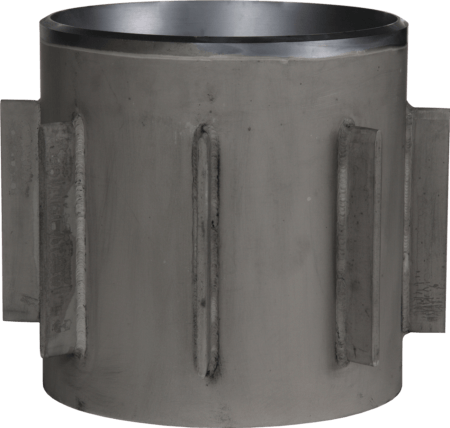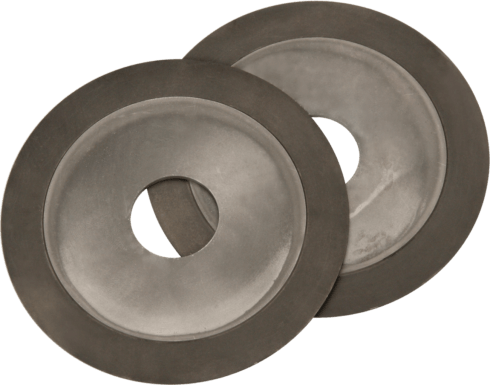
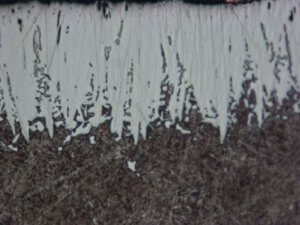
 Boronizing (also known as boriding) is a high temperature thermo-chemical surface hardening process in which boron atoms are diffused into the surface of a work piece to form complex borides (i.e. – FeB/FeB2) with the base metal. There is no mechanical interface between the complex borides and the substrate as this is a true diffusion process. The resulting case layer has a hard, lubricious surface capable of performing at higher temperatures than most surface treatments. Practically any ferrous material can be boronized, as well as many Ni, Ti & Co alloys. However, it is important to note that the higher the content of alloy elements, the slower the diffusion rate.
General Characteristics of Boronizing
- High temperature process (850˚ C/1562˚ F typical for ferrous materials)
- High hardness (1600-1900 HV in ferrous materials) of case layer
- Reduced coefficient of friction (0.4)
- High resistance to temperature (approx. 1200° F)
- Increases resistance to acids (especially Hydrochloric acid)
- Boronized layer can be polished after processing
- Reduced tendency to cold weld
- Suitable for a broad range of materials
- Boronized layer can be selectively applied
- Surface treatment can be uniformly applied to irregular shapes
- Heat treatable materials can be fully hardened after boronizing
- Uniform case depths of diffusion layers are controllable
Titankote™ B – Boronizing Technical Data
| Proprietary Name | Type | Composition | Color | Case Depth (microns) | Micro-Hardness (HV) | Coefficient of Friction | Maximum Working Temperature | Coating Process Temperature |
|---|---|---|---|---|---|---|---|---|
| Titankote™ B | Diffusion | Complex Borides* | Gray | 10-200** | 1600-1900*** | 0.4 | 650˚C/1202F˚ | 850˚C/1562F˚ **** |
* – The composition of the diffused layer will vary depending on the base material. For example, ferrous materials will form FeB/FeB2; nickel-based alloys will form Ni4B3/Ni2B/Ni3B; cobalt-based alloys form CoB/Co2B/Co3B; titanium-based alloys form TiB/TiB2.
** – The thickness/depth of the borided layer will vary depending on the base material. Ferrous materials will develop thicker layers; materials with a higher content of alloy elements tend to produce thinner layers.
*** – The micro-hardness of the diffused layer will vary depending on the base material. For example, FeB/FeB2 layers will have a micro-hardness in the range of 1600-1900 HV. Other elements, such as Ni, Ti and Co, will produce a different hardness range, some even higher than FeB/FeB2.
**** – The processing temperature will vary depending upon the base material. The temperature shown in the table is a common processing temperature for ferrous materials.
Typical Applications for Boronizing
Tooling
- Hot forging dies
- Wire drawing dies
- Extrusion dies
- Straightening Rolls
- Ingot molds
Oil & Gas Components
- Production tubing
- Valve components
- Valve fittings
- Metal seals
- Coal/Oil burner nozzles
General Components
- Nozzles
- Plungers
- Gears
- Shafts
- Rollers
Miscellaneous
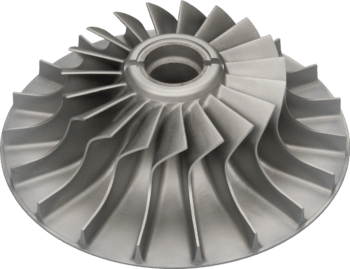
- Turbine components
- Pump impellers
- Ball valves & seats
- Shaft protection sleeve
- Guide bars
Suitable Materials for the Boronizing Process
This list is representational, but not all-inclusive: please contact us with questions regarding your specific application substrate.
Ferrous Metals
- Carbon steels
- Low alloy steels
- Tool steels (H13, D2, etc.)
- Stainless steels
- Gray & ductile cast iron
Non-Ferrous Metals*
- Tantalum
- Titanium
- Tungsten
- Niobium
- Molybdenum
Ti & Ni Based Alloys*
- Ti-6Al-4V
- Inconel 718
- Inconel 625
- Hastelloy
- Nimonic 80A
*- these materials typically require special processing, and are not available as a standard process.